
In Brazil’s e-commerce market, paying by credit card in installments remains one of the strongest factors influencing consumer purchasing decisions. Because installment payments are deeply embedded in local shopping behavior, merchants that want to succeed in the country must offer localized payment methods — especially local Brazilian credit card processing with installment capabilities.
At the same time, while offering more installments can significantly increase conversion rates, absorbing the full cost of interest-free installments can place considerable pressure on profitability. This creates an ongoing challenge for Shopify merchants selling in Brazil: how to offer competitive payment conditions without negatively impacting margins, cash flow, and the long-term financial sustainability of the business.
Traditionally, installment interest rules are configured based on a fixed number of installments. In practice, this means merchants must define exactly from which installment onward interest will be charged to the shopper, without considering the value of each individual installment.
This approach often lacks the flexibility needed to balance conversion and profitability effectively. A lower-value purchase split into many installments may create installments that are too small to justify the financing costs absorbed by the merchant, while higher-ticket purchases may allow for more attractive installment conditions without significantly affecting margins.
To solve this challenge, PagBrasil launched a Dynamic Installment Interest feature for Shopify, designed to make installment conditions far more intelligent, flexible, and customizable for local Brazilian credit card payments.
With this solution, merchants can apply interest on installment payments strategically based on the minimum installment amount rather than simply defining interest from a specific installment number onward. This gives businesses greater control over when to absorb financing costs, helps encourage higher average order values, and allows payment conditions to align more closely with the store’s financial strategy.
In this article, you’ll learn how PagBrasil’s Dynamic Installment Interest feature works, which rules can be configured, and how it can help your Shopify store increase conversion rates in Brazil without sacrificing profitability.
PagBrasil’s Dynamic Installment Interest feature: What is it and how does it work?
Dynamic Installment Interest is a feature that allows merchants to configure installment interest rules in the Shopify checkout in a far more flexible and strategic way. Merchants can still define standard settings such as:
- The maximum number of installments
- The minimum amount per installment
- How interest on installment payments will be passed on to the shopper
The key difference is that interest no longer has to start from a fixed installment number.
Instead, merchants can choose to link interest charges to the minimum installment amount, creating a much more dynamic and intelligent approach to installment management.
In practice, this means interest is automatically applied whenever the installment amount falls below the minimum threshold defined by the merchant.
For example, if a shopper makes a purchase worth BRL 500 and the store has configured a minimum interest-free installment amount of BRL 100, they will still see the option to pay in up to 10 installments at checkout. However, interest would begin to apply from the sixth installment onward, since each installment from that point would fall below the minimum amount configured by the store.
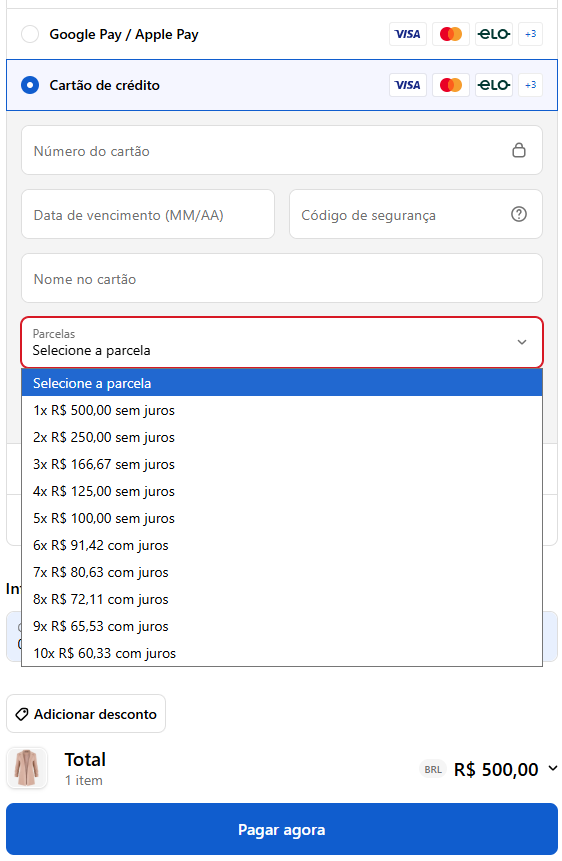
This means merchants only absorb installment financing costs on the sales that are most advantageous for their business, helping improve the long-term sustainability of the business.
At the same time, the strategy can help increase average order value, since shoppers may choose to add more items to their cart in order to unlock additional interest-free installments.
The result is a smarter checkout experience that balances conversion, customer experience, and financial control.
Which configuration rules are available?
PagBrasil allows Shopify merchants to configure installment conditions directly within the checkout, including the maximum number of installments and the minimum installment amount.
Traditionally, installment interest is configured based on a fixed installment number. For example, a merchant may offer payments in up to 10 installments while applying interest starting from the fourth installment onward.
With the Dynamic Installment Interest feature, PagBrasil introduces an additional configuration option: instead of defining a fixed installment threshold for interest charges, merchants can choose to apply interest dynamically based on the minimum installment amount configured for the business.
In practice, the system automatically evaluates the value of each installment to determine when interest should apply. Once the installment amount falls below the threshold configured by the merchant, the Shopify checkout automatically displays installment options with interest to the shopper.
This makes installment management far more strategic, allowing merchants to balance conversion rates, cash flow, and profitability without limiting the installment options available to customers.
How can interest on installment payments be charged?
In addition to defining when interest on installments should apply, merchants can also choose how the interest charged to customers will be configured.
PagBrasil offers two installment interest models: automatic and manual.
- Automatic model: PagBrasil automatically passes through to the shopper the same rate used for automatic receivables anticipation. This simplifies configuration and ensures the financing cost is transferred directly to the consumer.
- Manual model: Merchants can customize the interest rates charged to shoppers. This allows businesses to absorb part of the financing costs to offer more attractive payment conditions or, alternatively, apply higher rates as a strategy to optimize profitability.
This added flexibility gives Shopify merchants greater control over how installment payments impact both conversion rates and financial performance.
How do customers see installment interest at checkout?
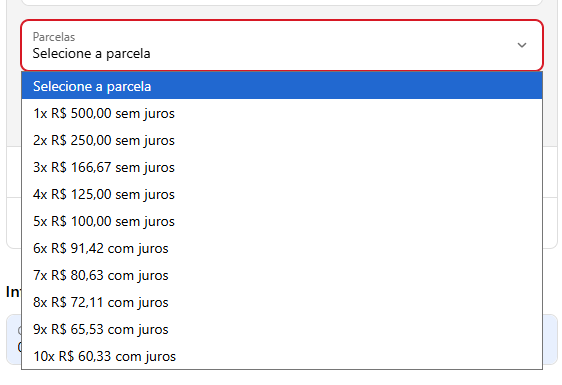
At the Shopify checkout, installment options are automatically displayed to customers based on the rules configured by the merchant. Depending on the purchase amount and the store’s installment settings, some payment options may appear interest-free while others are displayed with interest automatically calculated.
This dynamic approach keeps the checkout experience transparent, allowing shoppers to clearly understand which installment conditions are available for their purchase.
What are the benefits for merchants?
By making installment interest rules more intelligent and flexible, Dynamic Installment Interest helps Shopify merchants balance conversion rates and profitability far more effectively.
Below are some of the main benefits of the feature:
- Improved profit margin protection: By giving merchants greater control over when to absorb the costs of interest-free installments, the feature helps prevent scenarios where installment sales significantly reduce profitability.
- Higher average order values: Shoppers may choose to increase their cart value in order to unlock additional interest-free installment options, turning the checkout into an active tool for cart expansion.
- Greater flexibility for promotional campaigns and commercial strategies: Depending on business goals, merchants can offer more aggressive installment conditions to drive conversion or apply stricter rules to optimize financial performance.
- More adaptable installment strategies: Instead of relying on rigid installment interest models, merchants can tailor checkout conditions to their operational reality and customer profile. This flexibility enables more sophisticated installment strategies aligned with the company’s financial objectives.
- Choice between automatic and manual interest models: Merchants can choose the automatic model, in which PagBrasil automatically passes through the same rate used for automatic receivables anticipation, or the manual model, which allows fully customized interest rates. Even stores that do not use automatic receivables anticipation can still take advantage of the manual model, enabling greater financial control and more tailored installment strategies.
Make installment payments a competitive advantage with PagBrasil
The key differentiator of Dynamic Installment Interest is the level of customization it gives Shopify merchants.
While traditional installment models rely on fixed installment thresholds for charging interest, PagBrasil’s solution adds greater financial intelligence to the Shopify checkout, enabling merchants to create far more sophisticated installment strategies.
By linking interest on installments to the minimum installment amount, merchants can apply interest rules in a much more dynamic and strategic way.
In practice, this helps reduce unsustainable installment scenarios, improve financial control, and align payment conditions more closely with shopper purchasing behavior.
With this innovation, PagBrasil expands the customization possibilities of the Shopify checkout and transforms installment payments into a strategic tool for growth, conversion, and profitability.
Interested in this solution? Get in touch with our specialists.
Frequently asked questions about Dynamic Installment Interest
Dynamic Installment Interest is a feature that makes installment interest management in the Shopify checkout far more flexible and strategic.
Traditionally, interest on installments is applied starting from a fixed installment number defined by the merchant. With PagBrasil’s solution, merchants can instead choose to link interest charges to the minimum installment amount.
In practice, this creates smarter payment conditions that help balance conversion rates, profitability, and cash flow.
Interest on installments is applied automatically within the Shopify checkout.
Merchants can configure the maximum number of installments available and define how interest charges should be applied.
In the traditional model, interest starts from a specific installment number. With Dynamic Installment Interest, however, interest can be applied automatically whenever the installment amount falls below the threshold configured by the merchant.
As a result, some installment options may appear interest-free while others are automatically displayed with interest calculated at checkout.
Yes. Merchants can define from which installment onward interest should begin to apply.
For example, a store may offer payments in up to 10 installments while charging interest only from the fourth installment onward.
This flexibility helps merchants create installment strategies that better match their financial goals.
With Dynamic Installment Interest, merchants can link interest charges to the minimum installment amount configured for the store.
For example, if the store defines BRL 100 as the minimum installment amount threshold, installment plans that result in payments below that amount will automatically display interest at checkout.
This makes installment interest management much more strategic without limiting the installment options available to customers.
Yes. Installment conditions are displayed transparently within the Shopify checkout.
Depending on the purchase amount and the rules configured by the store, customers may see some installment options without interest and others with interest automatically applied.
Installment values are updated in real time, creating a clearer checkout experience and helping shoppers make purchasing decisions more easily.
Yes. Because installment interest can be linked to the minimum installment amount, shoppers may choose to increase their cart value in order to unlock more attractive interest-free installment conditions.
In practice, this turns the checkout into a strategic tool for encouraging larger purchases and increasing average order value.
Yes. Merchants can continue configuring the maximum number of installments and minimum installment amount as usual.
With Dynamic Installment Interest, they can also link interest charges to the installment amount itself, creating more flexible strategies to balance conversion, profitability, and cash flow.
With the automatic model, PagBrasil automatically passes through to the shopper the same rate used for automatic receivables anticipation.
With the manual model, merchants can define their own interest rates for checkout. This allows businesses to absorb part of the financing costs to offer more attractive payment conditions or optimize profitability with customized rates.
Yes. Even merchants that do not use automatic receivables anticipation can still use the manual interest model.
This allows businesses to create their own installment interest strategies and increase financial control without relying on automatic anticipation services.
Yes. The feature is available to Shopify merchants through PagBrasil.
By making installment interest management more strategic, merchants can avoid absorbing excessive financing costs on less sustainable installment sales.
This helps businesses better balance conversion rates and profitability, reducing the financial impact of interest-free installments while improving control over margins and cash flow.


