

The payment conversion rate is one of the most critical metrics for the revenue of any digital operation.
It represents the most decisive moment in the customer journey: when the consumer chooses to buy, enters their payment details, and expects everything to work seamlessly.
The problem is that many companies track this indicator based on incomplete data, relying on reports and metrics that mask technical issues and unjustified declines.
The result is a false sense of efficiency — and, worse, lost revenue.
In this article, we’ll show you how to calculate your true payment conversion rate, identify where the numbers may be “window-dressed,” and uncover practical strategies to increase approval rates.
What is the Payment Conversion Rate?
The payment conversion rate is a metric that measures how many purchases are actually approved after the customer decides to pay.
It reflects the performance of the final stage of the sales funnel, when an order has already been initiated and only depends on payment completion to be finalized.
This metric helps you understand whether your operation is successfully turning genuine purchase intent into revenue.
Technical issues, unjustified declines, or a lack of available payment methods directly affect this number. In turn, the payment conversion rate has a direct impact on a company’s revenue.
What’s the Difference Between an E-Commerce Conversion Rate and a Payment Conversion Rate?
The e-commerce conversion rate shows how many people who visit a website actually make a purchase.
It is calculated as follows:
- Website conversion rate = Total sales / Total visitors
This metric is useful for understanding the overall performance of an online store, but it does not reveal what happens at the most critical stage: the moment of payment.
That’s where the payment conversion rate comes in. This indicator shows how many purchase attempts actually turn into approved orders.
The formula is:
- Payment conversion rate = Approved payments / Total payment attempts
This metric has a direct impact on revenue, because the customer has already decided to buy. Any failure at this stage represents lost money — something that may be hidden or overlooked in standard reports.
Example of a Payment Conversion Rate
To illustrate the real financial impact of the payment conversion rate, imagine an online store that increases its payment conversion from 50% to 60%.
At first glance, this looks like a modest improvement. But when you apply it to 2,000 purchase attempts, the effect becomes clear. With a 50% conversion rate, the store completes 1,000 orders. At 60%, that number jumps to 1,200.
That’s 200 additional sales generated with the same traffic. In other words, a 10–percentage-point increase in payment conversion results in a 20% increase in sales.
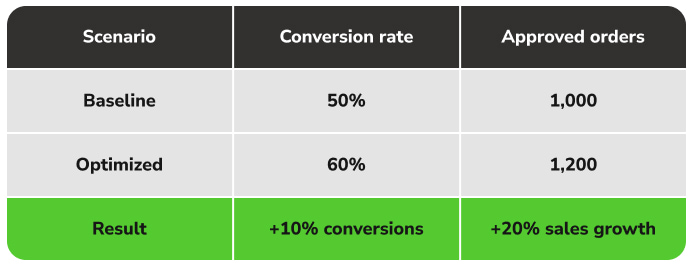
This is why it’s critical to look beyond percentage points and focus on relative growth. Conversion improvements compound on top of existing volume, revealing the true scale of their financial impact.
The effect is even stronger when starting from a lower baseline. For example, raising conversion from 30% to 40% still represents a 10–percentage-point gain, but it delivers a 33% increase in sales.
How Can You Tell Whether Your Payment Conversion Rate is Accurate and Transparent?
If the payment conversion rate shown in reports looks almost too good to be true, it’s because there’s a good chance that it actually is.
Common market practices can artificially inflate these numbers, masking process failures and making it harder to identify real optimization opportunities.
That’s why it’s essential to understand how this metric is calculated by your payment processor.
Below are three questions that can help you determine whether the data you receive reflects reality — or just a polished version of it.
Are Failed Payment Attempts Being Reported Correctly?
Failures related to the acquirer, the card issuer, or even the checkout infrastructure itself can cause a transaction to fail before it’s ever recorded as a payment attempt.
When these failures aren’t counted, the total number of attempts is artificially reduced. The result is an inflated conversion rate that hides a technical bottleneck in the operation.
It’s critical for your payment partner to provide full visibility into what actually happened with every attempt, including those that never even made it to processing.
Do Multiple Attempts by the Same Customer Count as a Single Order?
Another critical issue lies in how payment attempts are grouped. If a customer tries to pay three times — using two different cards and a Pix transfer, for example — and only succeeds on the last attempt, many platforms record the entire process as a single order.
In practice, this means ignoring two failed attempts. As a result, the conversion rate appears higher than it actually is.
This approach masks checkout issues such as integration failures, incompatibility with certain payment methods, or even unjustified declines.
Ideally, each attempt should be counted separately, allowing the entire operation to be audited end to end.
Is Your Fraud Prevention System Declining Legitimate Customers?
Fraud prevention systems are essential for protecting an operation — but they’re not infallible. Overly strict rules, for example, can lead to legitimate transactions being declined more often than many companies realize.
These valid purchase attempts that are mistakenly flagged as fraud are known as false positives, a problem that has a direct impact on a company’s revenue.
That’s why PagBrasil developed PagShield®, an intelligent fraud prevention solution that learns from customer behavior and helps maximize approvals for legitimate transactions.
Strategies to Increase Your E-Commerce Conversion Rate
Once you understand how to properly calculate and audit your payment conversion rate, the next step is to improve it consistently.
That means going beyond fixing isolated issues and building a smooth, stable process designed to maximize approvals for every genuine purchase attempt.
Below are three straightforward strategies you can apply to your operation.
Offer a Frictionless Checkout Experience
At checkout — one of the most sensitive stages of the purchase funnel — every extra second of waiting or unnecessary field increases the chance that the customer will abandon the purchase.
That’s why it’s essential to use a checkout solution that is stable, fast, and natively integrated, like PagBrasil Checkout (the next evolution of the payment link). This reduces the risk of technical failures and delivers a smoother experience, especially on mobile devices.
Another important factor is offering digital wallets like Apple Pay and Google Pay.
They allow customers to complete their purchase in just a few clicks, without having to enter card details manually.
Automate Recurring Payments to Reduce Delinquency
In subscription- or membership-based businesses, revenue predictability depends directly on consistent, on-time payments.
When the process is manual, every renewal becomes a potential point of failure: the customer forgets, a card reaches its expiration date, or the charge gets lost amid day-to-day tasks.
Automating recurring billing reduces these risks and improves cash flow. A best practice is to use recurring payment systems that send automatic reminders before due dates and update expired payment details.
These automations help prevent so-called involuntary churn, when customers stop paying not because they chose to leave, but due to operational friction or simple forgetfulness.
Traditionally, cross-border companies have relied on credit cards to manage recurring payments. In Brazil, however, this approach presents significant limitations: many consumers do not have credit cards, or their cards are not enabled for international transactions — creating unnecessary barriers to retention.
This is where Automatic Pix comes in. Automatic Pix allows customers to pre-authorize recurring payments directly through the infrastructure created for Brazil’s Pix — the most popular payment method in the country — enabling automatic charges without requiring manual action for each payment.
PagBrasil is the first payment processor to offer Automatic Pix, helping international companies reduce involuntary churn and unlock more reliable recurring revenue in the Brazilian market.
Offer Multiple Payment Methods Tailored to Your Audience
Some customers won’t give up the convenience of credit cards for online purchases. Many have already shifted to Pix, while others still rely on boleto bancário (Brazilian bank slip), especially in B2B transactions. And then there are digital wallets, which are becoming increasingly popular for their ability to deliver an even smoother checkout experience.
That’s why it’s essential to offer a broad range of payment methods tailored to your audience’s preferences.
With PagBrasil, merchants can make all of these options available within a single checkout, reducing cart abandonment and expanding the number of customers who are able to complete their purchase successfully.
When presented effectively, a diverse mix of payment methods is one of the simplest and most effective ways to increase your conversion rate.
Turn Payment Performance into Real Revenue Growth
Improving your payment conversion rate is one of the fastest, most predictable, and most sustainable ways to increase e-commerce revenue.
It doesn’t require more traffic, higher media spend, or long implementation cycles with complex testing.
Every additional percentage point translates directly into more revenue with the same customer acquisition effort, driving higher approval rates, stronger margins, and greater predictability.
To get there, however, you need access to the right data, with full visibility into failures, declines, and real opportunities for improvement — something you can easily gain access to with a specialized payment partner like PagBrasil.
Want a free analysis of your checkout’s conversion potential, with complete data transparency? Talk to a PagBrasil specialist.


